


'%20x='0'%20y='0'%20height='100%25'%20width='100%25'%20%0A%20%20%20%20%20%20%20%20%20%20xlink%3Ahref='data:image/jpg;base64,/9j/2wBDAAYEBQYFBAYGBQYHBwYIChAKCgkJChQODwwQFxQYGBcUFhYaHSUfGhsjHBYWICwgIyYnKSopGR8tMC0oMCUoKSj/2wBDAQcHBwoIChMKChMoGhYaKCgoKCgoKCgoKCgoKCgoKCgoKCgoKCgoKCgoKCgoKCgoKCgoKCgoKCgoKCgoKCgoKCj/wgARCAAGAAoDASIAAhEBAxEB/8QAFgABAQEAAAAAAAAAAAAAAAAAAAYH/8QAFQEBAQAAAAAAAAAAAAAAAAAAAwX/2gAMAwEAAhADEAAAALzKAqH/xAAhEAACAgAFBQAAAAAAAAAAAAABAgMEAAUGQVIREiElU//aAAgBAQABPwBM8zO/qzWOUrdPo5VFDvj8fZhJy44l1Nakld7U1k2GJMhjlKqW36DYY//EABYRAAMAAAAAAAAAAAAAAAAAAAADQf/aAAgBAgEBPwBkP//EABcRAQADAAAAAAAAAAAAAAAAAAEAAgT/2gAIAQMBAT8Ayglp/9k='%3E%3C/image%3E%3C/svg%3E)

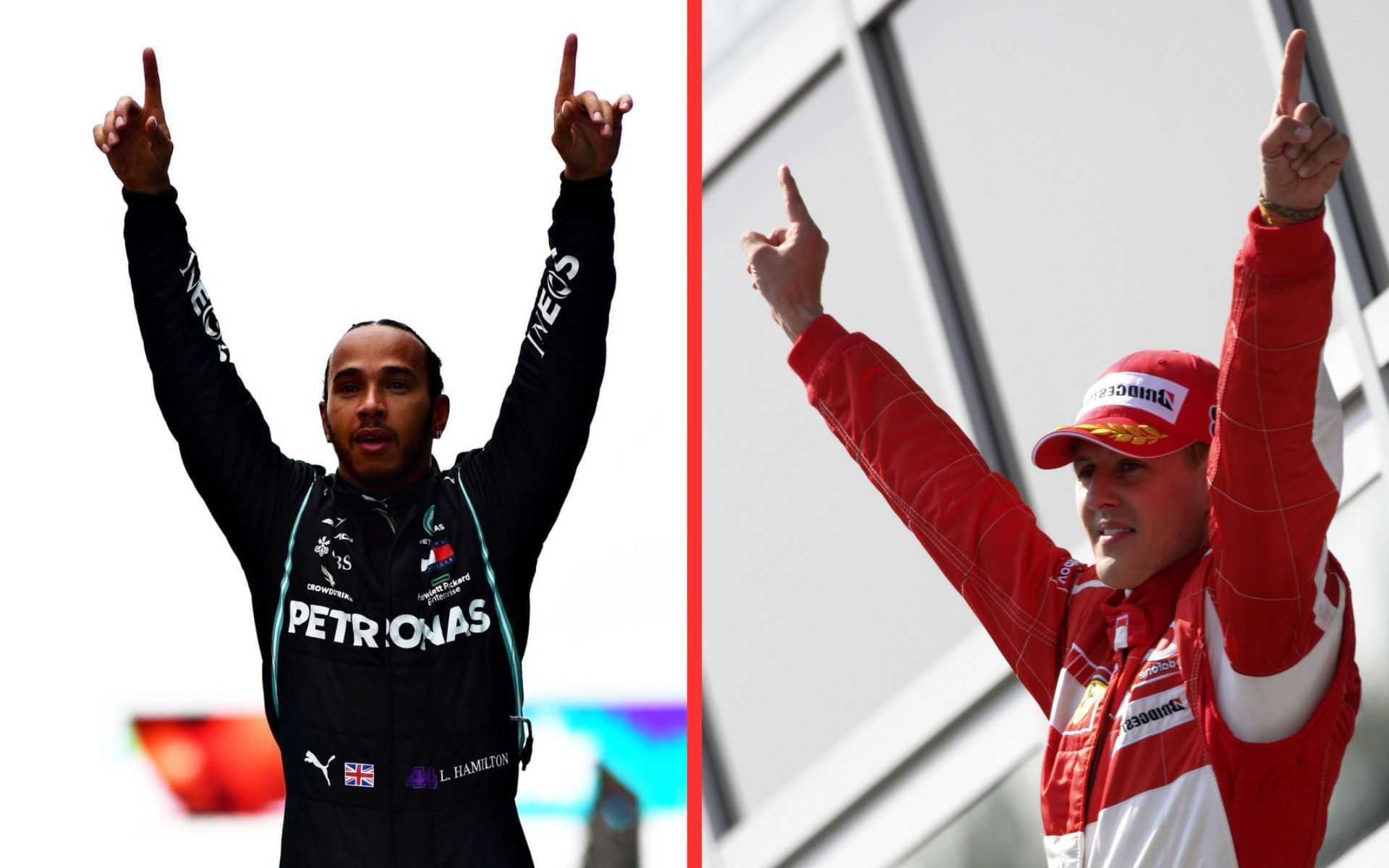
Lewis Hamilton and Michael Schumacher are the only two drivers in F1 history to win seven world drivers' championships. So, it's safe to say that the pair has a vast heritage in the racing spectrum and has had their dominant spells on the grid in their respective eras.
While the Briton is still on the grid, he achieved his prime in the F1 seasons between 2014 and 2021. In this time, he won six world championships and finished runner-up twice to assert his name over the F1 record books as one of the greatest ever.
On the other hand, Michael Schumacher had already won two world championships in the 1990s, but his dominant spell came at Ferrari between 2000 2000 and 2004. Here, he won all the world championships that were up for grabs and etched new records in F1.
 Trending
The German retired for a second time in 2012 and continues to live a life behind the curtains after his skiing accident. All the while, Hamilton has emerged as the face of F1 around the world, owing to his vast stardom.
Despite the differences in their personalities, the pair have the same number of world championships on paper, so let's compare their dominant spells in F1 against each other:
Lewis Hamilton's era (2014-21)
Lewis Hamilton had won one world championship in the 2000s. He had started his career at McLaren and then decided to move to Mercedes, a move that caught the paddock off guard as the Brackley-based squad was only an upper midfield team back then.
However, this gamble paid off, which led to the start of Hamilton's era in F1. In these seven years, he won six world championships, with Nico Rosberg and Max Verstappen being the only drivers to stop the Briton's championship-winning streak.
In these eight years, a total of 160 Grand Prix weekends were held, but he only participated in 159 race weekends due to his absence at the 2020 Sakhir GP after catching COVID-19. During which Lewis Hamilton was able to secure the following results:
- Wins: 81
- Pole positions: 72
- Podiums: 128
With the above-mentioned stats, it can be easily showcased how Lewis Hamilton dominated the sport in these seven years.
Michael Schumacher's era (2000-04)
On the other hand, Schumacher had joined Ferrari in 1996 and tried to bring the championship glory back to Maranello. He initially faced multiple near-misses, but he struck gold in 2000 when he won his first of five world championships for the team and began his hype train in F1.
In the five years, F1 held 85 Grand Prix weekends, where Schumacher secured:
- Wins: 48
- Pole positions: 40
- Podiums: 66
These stats showcase the firm grip that the German had over the F1 field. During this time, no driver apart from Michael Schumacher was able to score 10 or more Grand Prix victories, making his feat even more impressive.
But with the two champions' eras having a large disparity in the number of race weekends, a conclusion can be hard to derive. To counter this problem, taking out percentage figures and comparing them could take out one of the issues of such vast data.
So, without further ado, let's compare their percentage figures with each other:
Michael Schumacher vs Lewis Hamilton's eras
When converting their results figures into percentages, clear trends emerge. Though Lewis Hamilton has the greater number of wins and pole positions at first glance, Michael Schumacher had a better ratio of wins and pole positions.
But one area where Hamilton has the edge appears to be the podium section. Here, the then-Mercedes driver stood up on the podium four times out of the five race weekends he drove his car out on to the track.
This stat may come as a surprise as Schumacher is often praised for his 100% podium rate 2002 season, where he joined the rostrum all 17 times during that year. So, even this historical campaign wasn't able to counter Hamilton's impressive run of races during the turbo-hybrid era spell.
Thus, both the seven-time champions are legends of the sport, and their eras of dominance compare closely to each other, with each driver holding an upper hand in one category or the other.
Apart from this, if you want to compare the pair's statistics on a seemingly level playing field, you can check it out here


