


'%20x='0'%20y='0'%20height='100%25'%20width='100%25'%20%0A%20%20%20%20%20%20%20%20%20%20xlink%3Ahref='data:image/jpg;base64,/9j/2wBDAAYGBgYHBgcICAcKCwoLCg8ODAwODxYQERAREBYiFRkVFRkVIh4kHhweJB42KiYmKjY+NDI0PkxERExfWl98fKf/2wBDAQYGBgYHBgcICAcKCwoLCg8ODAwODxYQERAREBYiFRkVFRkVIh4kHhweJB42KiYmKjY+NDI0PkxERExfWl98fKf/wgARCAAGAAoDASIAAhEBAxEB/8QAFQABAQAAAAAAAAAAAAAAAAAAAAX/xAAUAQEAAAAAAAAAAAAAAAAAAAAE/9oADAMBAAIQAxAAAACBCBM//8QAHhAAAgEEAwEAAAAAAAAAAAAAAQIEAAMFBhESIWH/2gAIAQEAAT8AxG75mO2RirJui1Hsd06kKxb6SD5TbLsFxi5y0nljzX//xAAaEQACAgMAAAAAAAAAAAAAAAABEQACAzGx/9oACAECAQE/AMYdrtnXJ//EABgRAQADAQAAAAAAAAAAAAAAAAEAAhEh/9oACAEDAQE/ALcDAJ//2Q=='%3E%3C/image%3E%3C/svg%3E)

ARC Raiders is the latest Unreal Engine 5-based video game in the market, which has historically raised performance flags in the past. While the game ships with the full DLSS 4 stack with Transformer-based upscaling and Frame Generation, nothing beats optimized CPU pipelines and proper render-thread parallelism even on high-end GPUs. To test this, we benchmarked the game with the RTX 5080 16 GB — one of the highest-end video cards today.
Read on to find out what kind of framerates you can expect from the new shooter-looter.
ARC Raiders runs smoothly on the RTX 5080 at 4K resolutions
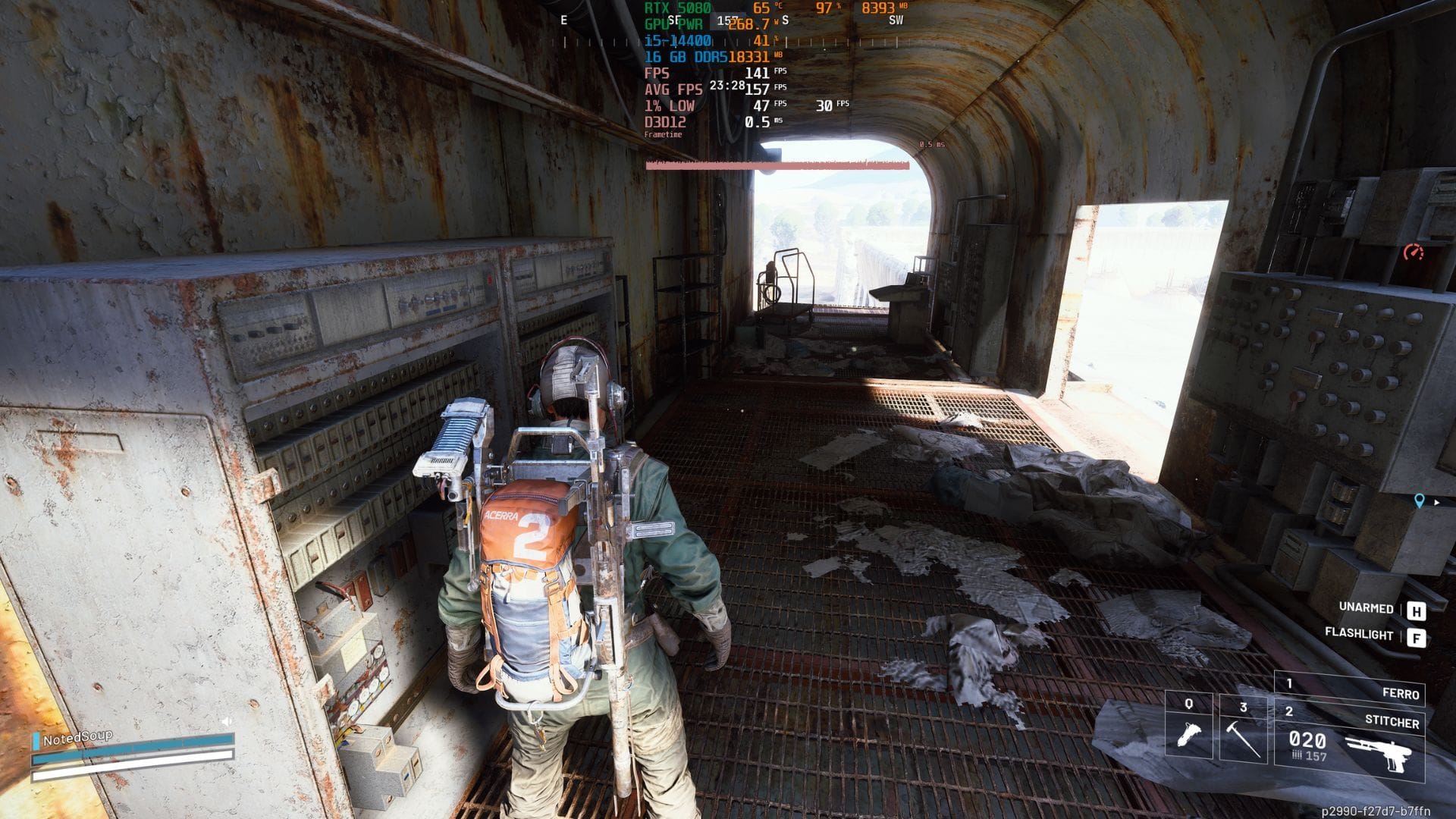
At 4K, ARC Raiders is quite playable. Specifically, you can turn off DLSS and any form of upscaling and still get 100 FPS consistently. However, a closer look at the 0.1% and 1% low numbers tells that performance doesn't scale linearly. We note that the 3× → 4× is massive at 1080p (239 → 386 FPS ) but only 181 → 239 FPS at 4K. This suggests a rather unstable engine with FG at high multipliers.
 Trending
GPU: RTX 5080; Resolution: 3840 x 2160; Test: ARC Raiders Spaceport
Coming to native resolution numbers, we see little difference between RT High and Epic settings (104 vs 101 FPS on average). RT Static is the lowest-end setting in the title, which scales framerates further to 116 FPS. This further suggests that if you have a modern graphics card, ray tracing won't be the bottleneck. Let's test a lower resolution to better understand the CPU-GPU dynamic in this CUDA workload.
Read more: Battlefield 6 performance review: RTX 5090 and RTX 5070 tested
ARC Raiders 1080p performance test
At 1080p, the game is more CPU-bound. We note only 87 FPS on average with DLAA + RT High settings, with 0.1% lows of 21 FPS. Switching to RT Static (which, bear in mind, delivered a 15% advantage in 4K), jumps the 0.1% lows from 21 → 41 FPS. This suggests that scene animation and world simulation are the most demanding features of the game, both of which remain locked to UE5-based mechanics.
Moreover, the DLSS Quality preset doesn't improve performance over DLAA, which suggests a hard renderer thread saturation. This, again, can be attributed to an engine-specific optimization failure.
GPU: RTX 5080; Resolution: 1920 x 1080; Test: ARC Raiders Spaceport
Specifically, RT with DLSS drops the 0.1% lows to just 12 FPS, which is a counterintuitive result hinting at a CPU-heavy workload. Static RT avoids any BVH rebuilds, unlike the Dynamic preset, hence the general consensus is a reduction of stutters (read: higher 0.1% and 1% low numbers).
Overall, only frame generation improves performance beyond 200 FPS, but that's largely conflating average FPS numbers without contributing to gameplay smoothness (homogenous 0.1% and 1% low numbers across the board).
Considering all of this, we conclude the 1080p behavior is largely in tune with UE5 Nanite/Lumen behavior. The RT implementation is also quite CPU-heavy. Lastly, scene complexity, which makes the game look visually appealing, doesn't lead to massive performance gains by switching Dynamic and Static RT settings.
Overall, ARC Raiders has several problems in its optimization, most of which can be attributed to the underlying UE5 engine. The game is largely CPU-bound in RT and pretty inefficient at lower resolutions at 1080p. While there aren't any glaring performance hiccups on high-end GPUs like the RTX 5080, and casual gamers can have a good time, smoothness on low-end cards is a concern.


