


'%20x='0'%20y='0'%20height='100%25'%20width='100%25'%20%0A%20%20%20%20%20%20%20%20%20%20xlink%3Ahref='data:image/jpg;base64,/9j/2wBDAAYEBQYFBAYGBQYHBwYIChAKCgkJChQODwwQFxQYGBcUFhYaHSUfGhsjHBYWICwgIyYnKSopGR8tMC0oMCUoKSj/2wBDAQcHBwoIChMKChMoGhYaKCgoKCgoKCgoKCgoKCgoKCgoKCgoKCgoKCgoKCgoKCgoKCgoKCgoKCgoKCgoKCgoKCj/wgARCAAHAAoDASIAAhEBAxEB/8QAFgABAQEAAAAAAAAAAAAAAAAAAAQG/8QAFAEBAAAAAAAAAAAAAAAAAAAABf/aAAwDAQACEAMQAAAAw1owd//EAB0QAAICAgMBAAAAAAAAAAAAAAECAxEABAUGE1L/2gAIAQEAAT8A47t6Ra80CSOROfKQvELMfzePy0Suwi1tTzBpbD3Wf//EABcRAAMBAAAAAAAAAAAAAAAAAAACAwH/2gAIAQIBAT8AlJdY/8QAGBEAAgMAAAAAAAAAAAAAAAAAAAEDESH/2gAIAQMBAT8AkdYf/9k='%3E%3C/image%3E%3C/svg%3E)

Twelve years ago, India had the privilege of hosting the Women's ODI World Cup, for the first time since 1978. But it was far from a spectacle, with only two venues put to use (fewer than the 1978 edition), ones with history, but none of the glamour.
A dusty Brabourne hosted the final, with Australia yet again clinching the title, and with nary a crowd in sight. Odds are that a bigger crowd must have been assembled on the Marine Drive just outside the venue, oblivious to what is happening behind them, and even if they aware, they could not be bothered.
And Team India? Nowhere in sight in any way, shape, or form, after a tame group stage exit. The distressing sign for the Women in Blue was the fact that domestic sides like Odisha and Mumbai, were a bigger threat to the visiting countries as they racked up wins over Sri Lanka and Pakistan during the warm-up matches.
 Trending
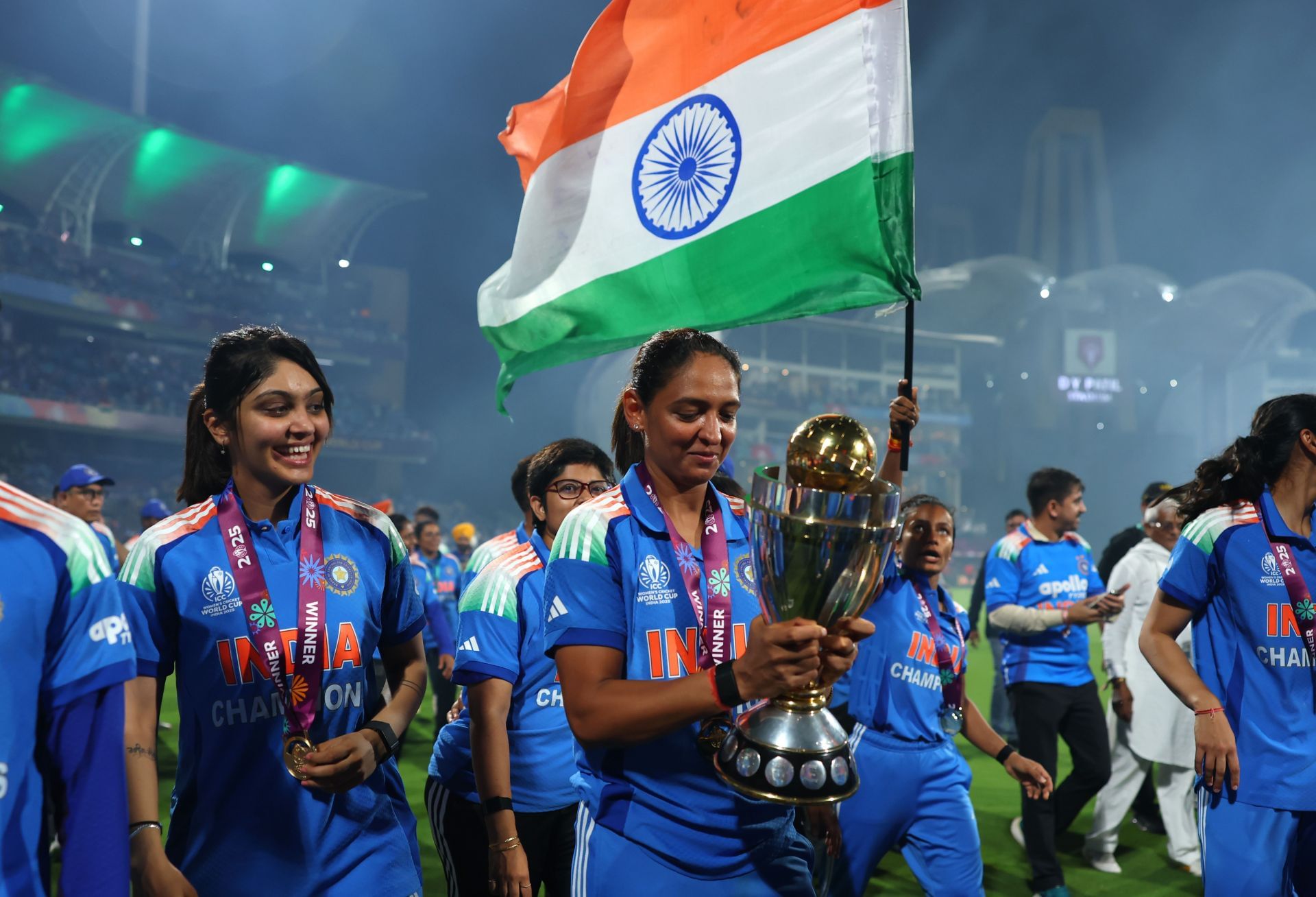
Fast forward to the present, just a hop, skip, and a bridge away from the symbolic graveyard that was Brabourne, the DY Patil Stadium in Navi Mumbai was the shrine where the Indian women's team cemented their legacy.
The 12-year period witnessed a massive overhaul in the sport, in terms of skill level, marketing, opportunities, and globalization. To the credit of the team, they were able to make full use of ICC and the BCCI's efforts to make women's cricket releveant, and if this World Cup win does not help that cause, then nothing will.
The Indian women's team can finally establish a new identity for themselves after the 2025 ODI World Cup triumph
Women's cricket's ideal goal, which was deemed unrealistic in the past, was to create a separate identity and not just piggyback on men's cricket. Whether it be misogynistic advertisements, the sympathy or charitable plug-ins during the men's games, or the senseless and humiliating comparisons like the boundary size difference.
To this day, there arguably must not have been an advertisement to promote the Indian women's team without the mention of the men's team in some way or the other. Whether it be jersey numbers, or the mention of star men's players, or any other possible connection they could muster up, it felt a forced measure. As if Indian women's cricket cannot possibly exist without the popularity of the men's team.
Although the efforts were largely sincere, aiding in the promotion of women's cricket at the end of the day, which was a needed measure, the way of going about it was not right. It was two steps forward and one step back.
Hopefully, through the 2025 World Cup win, women's cricket in India has reached such a stage, that it can be promoted independently. Women's cricket does not need men's cricket to exist or function. Those days are over. Period. And that is one of the biggest takeaways from the 2025 ODI World Cup win. They are finally unshackled from the unintentionally parasitic trend, and the dreaded overlap in the Venn diagram. The broadcasters are invested, the advertisers are interested, and the fans are more in than ever, what more does a sport need?
The WPL and the increasing frequency of bilateral wins meant that this moment was coming sooner or later, but an achievement of this magnitude helps them carve a separate niche for themselves altogether, the promised land where they can flourish even more.
India's World Cup success was not destiny or god's plan, but the evolution of growth in its purest form
There will be concrete efforts by the storytelling fanatics to bring the element of destiny or god's intervention into Team India's World Cup win. While there is no wrong in thinking or doing so, the more you do, the more you are disregarding the sheer hard work, dedication, and the efforts put in not only by the players, but also the entire framework to bring life into women's cricket in India.
A recurring theme regarding destiny has revolved around Shafali Verma, who played a vital role in the final after coming in as an injury replacement for Pratika Rawal. But from another perspective, a much more practical one, isn't it the sign of massive improvement that India had the provision of calling upon a massive talent like Shafali Verma as a replacement from the sidelines? Would it have been possible four years back?
The growing bench strength, players being accustomed to playing under pressure, and their newfound ability to get over the barrier and not just push opponents to the ropes, are all signs that this is just the beginning, like captain Harmanpreet Kaur asserted during the post-match presentation.
Another major trait that this Indian team have shown is their ability to learn from their mistakes. Often in the past, we have witnessed the same-old bottle jobs, where the team just freezes when up against certain occasions or situations.
To be fair, some of those traits were still on show midway through the tournament, particularly during the losing streak. But, knowing that they were knocking on the door after all those three losses, the team pulled up their socks, and decided to be at their ruthless best to not let the opposition into the game. In all their crunch fixtures against New Zealand, Australia, and South Africa, they played some of their most dominant cricket ever in ICC events.
New Zealand were never in the contest. India showed enough composure to restrict Australia when they were running away with the game. Their highest form of tranquility, perhaps in history, came during the run chase when they trusted a venue they were familiar with and did not let a steep target faze them at any stage.
And once again, that same composure was shown in the final. even after they were put into bat first after a delay against a big crowd, or even when South Africa were looking in a stable position during the run chase. The team was patient, and worked hard for the breakthroughs that they knew would come as long as they kept calm.
There were no head loss moments. Sure, there are still avenues for improvement, as with any other team, for instance, the fielding, but every Indian, will take this for the time being, as it is a massive launch pad, one that does not come around very often.
Women's World Cup 2025 extends beyond India's win
The magnitude of this win reverberates, not only impacting Indian women's cricket, but also women's cricket in general. An underrated aspect of the final, almost lost amid all the frenzy courtesy of the win, was how Laura Wolvaardt's knock was appreciated.
The South African skipper earned a standing ovation from the crowd despite the fact that she was an opponent hampering the chances of the home country. She also earned a loud cheer when her name was called up for the post-match presentation, and as of now, her Instagram is flooded with positive comments from Indian fans who are praising her knock, as well as consoling her.
Usually, the comment section of women's cricketers are riddled with questionable remarks on several levels, but the support that fans have shown to an opponent in the most heart-warming way possible, is just another layer to show how women's cricket has won over the world. There are countless other examples from the World Cup campaign to show how women's cricket is being more and more cherished, but this one stands out by a mile.
For India as a nation, this is another sporting silverware they can proudly add to their glittering and overflowing trophy cabinet, making it seem small in the grand scheme of things. However, what it represents, especially after all the years of anguish, misogyny, abuse, disregard, and trolling, makes it a bit more shiny than the rest.
The trophy is not the only piece of silverware they won, the win also hands them the keys to the future of women's cricket. The sheer growth that the game will witness from here on, courtesy of this single win, might show that the Women's World Cup needed India more than India needed the Women's World Cup.

Looking for fast live cricket scores? Download CricRocket and get fast score updates, top-notch commentary in-depth match stats & much more! 🚀☄️


